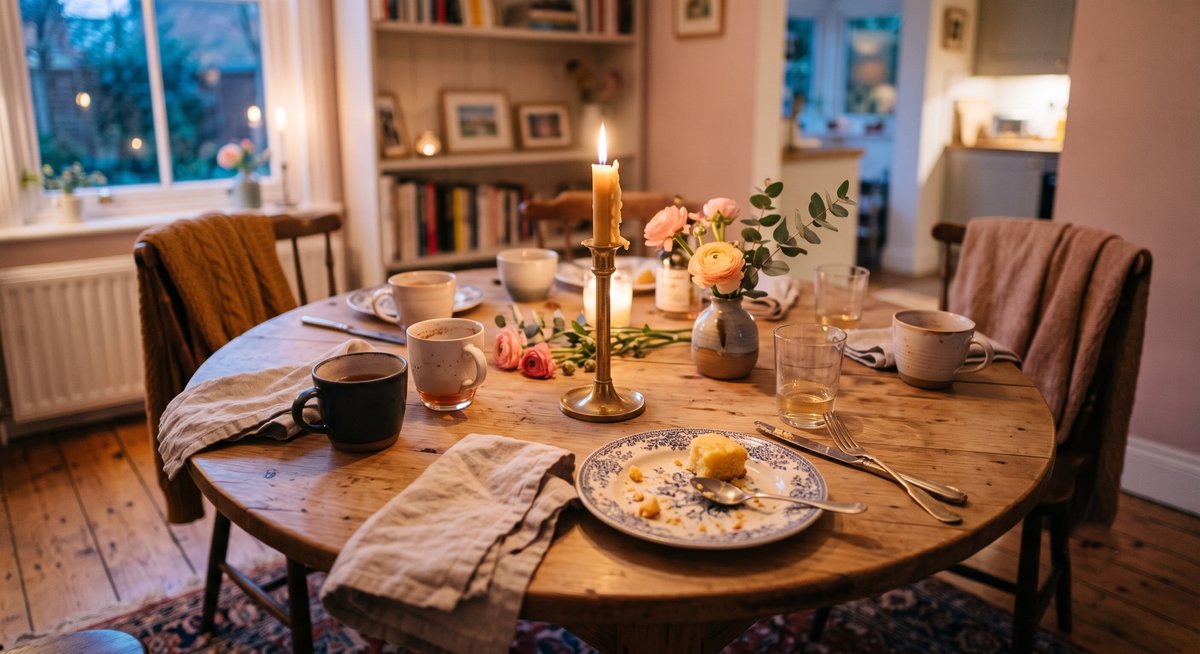
Everyone remembers the celebrations I created.
I remember standing at the edge of them, checking whether everyone else was happy.
For years, I was responsible for more than the practical parts of family life.
I remembered dates.
Bought what was needed.
Planned the food.
Made the bookings.
Found the missing candles.
But somewhere along the way, another responsibility attached itself to the list.
The mood.
I became the person who made sure things felt special.
If an evening was quiet, I tried to lift it.
If a celebration felt flat, I added something.
If people were tired or tense, I found a way to smooth the moment before it changed the memory everyone was supposed to be making.
No one officially gave me this role.
There was no conversation.
It happened the way so many invisible responsibilities happen.
I noticed what was missing.
Then I became responsible for making it appear.
At first, I loved parts of it.
There is real joy in creating something beautiful for people you care about.
In choosing the small detail that makes someone's face change.
In turning an ordinary table into a place people will remember.
But slowly, joy became another thing I managed.
I was not only preparing the moment.
I was monitoring it.
Was everyone comfortable?
Was anyone feeling left out?
Did the children seem excited enough?
Was the music right?
Did the food come out at the right time?
Was someone becoming quiet?
Did the conversation need rescuing?
I could be in the centre of the room and still be watching it from somewhere outside myself.
There was one gathering when I finally noticed.
I had planned it carefully.
People were laughing.
The food was good.
Nothing had gone wrong.
It should have felt like success.
Instead, I caught myself standing in the kitchen, listening to the laughter in the next room while mentally checking what still needed to happen.
More drinks.
Clear the plates.
Bring out the next thing.
Make sure someone took photographs.
I was present in every photograph and absent from the moment.
That thought stayed with me.
I had become the stage manager of other people's happiness.
I made sure the lights came on.
The right things appeared at the right time.
Everyone knew where to stand.
But I was always just outside the scene, waiting for the next cue.
The difficult truth was that I did not know how to simply participate.
Enjoyment had started to feel irresponsible.
If I stopped watching the room, what might I miss?
If I relaxed, who would keep the energy going?
If I sat down, would the evening lose something?
Maybe it would.
But I was beginning to understand that every memory does not have to be perfect to be worth living.
A flat moment is not a failed evening.
A little silence is not an emergency.
People can create their own laughter.
They can notice when the music stops.
They can decide what happens next.
I do not have to manufacture every good feeling in the room.
That was harder to accept than it sounds.
Being the fun one had protected me from something too.
If I was busy creating the mood, I did not have to notice my own.
I could keep everyone laughing without asking whether I felt like laughing.
I could make the day special without admitting I was tired.
I could remain useful even inside joy.
Lately, I have been trying to arrive at good moments differently.
I still plan.
I still care about details.
That part of me is real, and I do not want to lose it.
But I am trying not to hold the entire atmosphere in my hands.
Sometimes I let someone else choose the music.
I let the table be less perfect.
I leave a pause alone instead of rushing to fill it.
I sit down before every task is complete.
At first, it feels like neglect.
Then, slowly, it begins to feel like being there.
I hear the full story instead of half-listening while making a list.
I laugh because something is funny, not because the room needs more energy.
I appear in the memory as a person, not only as the one who made it possible.
There are moments when things are less organised now.
Someone forgets something.
The timing slips.
The evening takes a direction I did not plan.
And still, people enjoy themselves.
Sometimes more than they did when I managed every detail.
That has taught me something important.
Joy needs care, but it also needs room.
It cannot always breathe when one person is responsible for keeping it alive.
If you have become the person who manages everyone's good time, perhaps you know this kind of tiredness.
It is possible to create beautiful memories and feel lonely inside them.
It is possible to be thanked for a wonderful day you barely experienced.
I do not want to stop making things special for the people I love.
I only want to stop disappearing from the things I make.
I do not want to look back and realise I spent years arranging everyone's happiness from the edge of the room.
I want to be in the laughter.
In the imperfect photograph.
In the moment that did not go according to plan and was still worth remembering.
I want to be more than the person who made the memory happen.
I want to be someone who lived inside it too.
Before You Go
If you have spent years making the memories while standing just outside them, I hope you let yourself enter the frame sometimes. Let the evening be imperfect. Let someone else notice what is missing. Let yourself laugh before checking whether everyone else is laughing too.
Joy was never meant to become another performance of usefulness.
The next story goes into one of the loneliest contradictions in this series: being surrounded by people who depend on you while having no clear idea who you are allowed to depend on.